Stepping Into the Unknown

It’s a dangerous business, Frodo, going out your front door. You step into the road, and if you do not keep your feet there is no knowing where you might be swept off to. – Bilbo Baggins, Lord of the Rings

It’s clear all the way through history that practices are primary and beliefs are secondary. – Robert N. Bellah

In less than a month I’ll embark on my first Camino de Santiago. I’m leading a group of novices who will each step foot on this ancient path toward Santiago de Compostela for the first time. This means the way is completely new and unknown to each of us. Though I am organizing the trip, none of us are experts. Which I am guessing will be a unique feature.

The concept of pilgrimage is not new to me. I’ve read memoirs, studied the history, and written often about it, making it central to my doctoral thesis. But I’ve been surprised at the difficulty I’ve encountered describing to others why I believe a pilgrimage is a necessary component of a growing life of faith. Further, why should someone entrust me with their hard-earned money and time off in order to hoist a backpack on their back and walk an average of 12 miles a day along the dusty trails of northern Spain? Honestly, it’s been a frustrating experience, given my “expertise.”

But just this week it occurred to me why it’s so hard to convince the masses to walk toward an old Cathedral in Spain that supposedly houses the remains of Saint James: I’ve been appealing to their head instead of their heart. So much of education and faith formation over the last 400 years has focused almost exclusively on knowledge. Thanks to René Descartes, humans have placed more and more value on what we can know and control, rather than what we intuit, feel, and experience. For the religious, this means we’ve placed primacy on what we believe, rather than our experiences. 

And so western Christianity has placed increasing emphasis on explaining and then defending a faith that beforehand had been largely understood in terms of relationship and mystery. I can’t convince you that Jesus is God incarnate any more that I can convince you that walking for eight days, ten days, or two weeks will bring about transformation. Nor can I sway you to see this as a good thing – especially if you believe your life is already pretty good. 

But an overlooked fact remains – we are relational creatures who make meaning through experiences. And an encounter with the risen Christ and the hospitality of a stranger along a well worn trail can change you. It’s also why a concert shared with thousands in a stadium can be so exhilarating, a week at a youth camp can be so moving, or sharing a unique culinary experience can be so memorable. Shared experiences touch the heart and the head through our five senses. Which is why experiencing the warmth of the sun, the deep greens of the rolling hills, the chatter of a babbling brook, the ache of sore feet at the end of the day, and the salutation of “Buen Camino” by a fellow pilgrim can widen our appreciation for God’s gifts in a way that beliefs alone simply cannot.    

If we are lucky, we have at least one pivotal experience when we are young. It might be learning to live on our own, when we only have pennies to our name but time to embrace new ideas and new friends. It might also be a trip that takes us away from the familiar, briefly giving us time to examine our life and the world from a different angle. As we age, these experiences might come in the form of a surprise – we lose a job, a loved one suddenly dies, or a relationship ends. 

I can name many of these experiences over my life. And so far, each of them has taught me as much about myself and God as any doctrine or dogma. Put positively, scripture and tradition help us recognize the goodness of God in our experiences and guide our journey toward more encounters of the gratuitousness of God in all of creation. 

These moments shouldn’t be relegated to early life or special missionary callings. Instead, everyone can find ways to practice pilgrimage. We all can benefit from routinely removing ourselves from the day-to-day so that we become attune to God’s presence. In so doing, we may be surprised just how often we encounter God’s Spirit shimmering in a placid lake, or in the cool of a morning breeze, or in the hospitality of a stranger. 

Pilgrimage is a practice that intentionally places us in the unknown in order that we might experience God in ways that a set of beliefs alone cannot provide. We certainly carry scripture and tradition with us into this practice, but doctrine by itself is flat whereas a pilgrim crackles and pops with energy, giving life to the beliefs we profess. 

Life Together During a Pandemic

In 2020 we have experienced more disruption, change, suffering and loss than imaginable.  Much of what we have come to depend on has either been put on pause or stopped altogether.  Such large-scale change and disruption can tear at the fabric of social institutions.  The church, however, when at its healthiest, expects these storms to come and is nimble enough to weather them because its hope isn’t found in traditions, status or familiar routine.  Rather, according to Dietrich Bonhoeffer, the Christian community reflects its assurance in God through its life together based on:

  • Spiritual love for one another rather than emotional love
  • Spiritual practices that keep God in the forefront, not the background
  • Solitude before God rather than noise of self-righteousness  
  • Service to another through listening, active helpfulness and forbearance
  • Confession of sins from one Christian sinner to another 

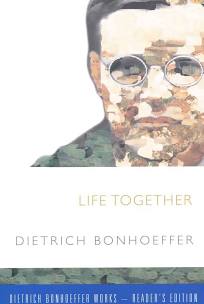
Bonhoeffer devotes a chapter to each of these in his classic book, Life Together.*  Bonhoeffer knew something about Christian life lived together before God; as a professor at Finkenwalde Seminary he was molding the lives of seminarians in the face of the rise of Hitler’s Third Reich.  Everything that Christians had taken for granted about their lives in enlightened Germany were being challenged.  A devout nation, Germany was also on the cutting edge of art, philosophy and innovation.  But out of such success came collapse after the great war, the worldwide depression and devastating inflation that left Germany weak and uncertain. 

Church leaders in Germany traded influence in Hitler’s Third Reich in exchange for a prophetic witness.

The Covid-19 pandemic, a renewed racial reckoning, partisan political rancor, job loss, school closings and no sports (!!!)  have left our heads spinning and grasping for something certain to hold on to.  How should Christians respond in the face of so much change, so quickly?  Bonhoeffer’s Life Together has helped me address this question.  He was clear that an individual Christian’s faith was tied up in the participation and purpose of the larger Christian community.  He believed a Christian community’s life together can withstand these disruptions because its purpose is founded on honoring God’s work in sinful people despite their brokenness.  Their shared daily practices, selfless love, Bible reading, meditative prayer, service to one another and confession didn’t change when the world around them changed.  Rather, these practices prepared them to face difficulties.  They defined the community.  

The world around the faith communities have been altered for the foreseeable future.  Consequently, we have had to change some of the familiar ways we gather for worship and discipleship.  But, has such changes impacted who we are and why we exist as a faith community?  Where we feel it has, we must look at the practices and expectations that make us feel this way.  Are they from God or from our own emotional reaction?  Where we have held firm in devotion to God, we should celebrate and continue in that path.  

Bonhoeffer is teaching me that while changes will come to society and to our churches that are scary, not only can we find blessed assurance in the core practices of our faith, they can pave the way to new life and vitality for our tomorrow.  Pray for the church and its leaders as we navigate this path.  May we do so with humility, forbearance and grace toward one another, because otherwise, change is so hard.  

*Check out Dietrich Bonhoeffer’s Life Together.  There are editions available from Harper Collins and Fortress Press.  It is a brief but “meaty” volume that will have you chewing on God’s wisdom for days and weeks to come.       

Healing Presence

Below, I start by restating the student sheet introduction statements.  Then, I give my impressions followed by a couple of video illustration suggestions.

What is important to know?  Jesus is not scared of brokenness – either physical or spiritual.  His willingness and ability to heal draws a crowd.  Jesus can give them what they long for.  What is it that they long for?  (Wholeness?  Acceptance?  New life?)

Where is God in these words?  Jesus’ healing is powerful.  The Greek word egeiro is used here and in Mark 16:6 in reference to Jesus’ resurrection.  It seems that Jesus’ work is not healing just for healing sake.  It is restorative.  For Simon’s mother in law, her social responsibility to was to provide for guests when they were present in her home.  Today, her guest was none other that the Son of God!   The healing restored to her the social expectation and meaning for a homemaker in 1st century Palestine.  It restored her dignity.  Don’t mistake the role of Simon’s mother as normative for today, however.  That would be missing the point!

So what does this mean for our lives? God recognized that nearness and even touch were important for building a relationship and trust.  Thus, God put on flesh and came near to his creation he was seeking to re-connect.  The incarnation, God becoming flesh, is a astounding show of God’s love for creation.  Jesus was willing to come into contact with all kinds – no matter their ailment.  That means none of us are ever to far gone for Jesus to come near to us and restore us!  In Mark 1, that included the demon possessed, the sick and the unclean – those skin diseases believed to be spread by touch.  If Christians are considered the body of Christ, what does our willingness or unwillingness to associate with others say about who Jesus is?

Now what is God’s word calling us to do?   How have we been healed and restored by God’s word or by God’s healing touch?  How has that healing allowed us to use our words and deeds to heal and restore others?

All of us are children of God, created in the image of God.  All of us also live in a world where sin still is present.  We can’t deny it – every new day brings heartache and disappointment for so many.  Our human condition brings with it the capacity to do great and creative things and to fail; to hurt others and let others down.  Some bodies are capable of at one point running a sub-four minute mile or jumping hurdles and the next moment succumbing to cancer.  It leads us all to ask, where is God in this?  If we are created in God’s image, why all the pain, the sickness, the heartbreak?  How are we, God’s children, capable of such beauty and such evil?  The simple answer, of course, is sin.  The sin that started in our inability to fully trust God but rather to think of ourselves as God.  Its that same sin, our desire to think of ourselves as God that prevents us from most fully reflecting the image of God.  Rather, its in our humility to trust God fully and to put our neighbor first that is ironically the way we reflect the divine.

Mark introduces Jesus, the Son of God, in fast-paced snippets.  We learn about John the Baptist, Jesus’ baptism, Jesus’ wilderness temptations, Jesus’ proclamation that he embodied God’s reign come near and his call of his first disciples, all within the first 20 verses of chapter one!

Then, we find Jesus teaching in the synagogue on a Sabbath.  He spoke with authority, which is to say he was interpreting the scriptures without the help of another teacher or prophet.  (See N. T. Wright, Mark for Everyone p. 11, last paragraph).  Who better to recognize the authority of his teaching than the demon possessing a man present in the synagogue?  The demon obeys Jesus’ command and the assembly is amazed.

The scene switches to Simon’s mother-in-law’s home.  There, she is sick and unable to offer the typical hospitality that was expected of a first century Jewish home.    We don’t know anything about her illness.  But what seems to be significant is that Jesus is able to restore her health in such an effective way that she begins to serve her guests.  I don’t think this is a story about God’s desire for gender roles.  What it does speak to, however, is that in Jesus’ day, a woman’s role was wrapped up in her ability to offer hospitality to her guests.  Her sickness may have been grave.  She may have been brought back from the brink.  But at the least, her dignity was restored as she was able to provide what her peers would have expected her to do with guests in her home.

In the section after our reading, Jesus and his disciples happen upon a leper.  Lepers were some of the untouchable in Jesus’ day, with fear that their skin disease would be caught not just by touch but if they were within eye shot of others.   Therefore, lepers existed outside towns, alone and ostracized. This leper also recognizes who Jesus is and asks for healing.  Jesus is filled with compassion instead of repulsed as most would have been. (the Greek is splagchnizomai which is translated indignant or filled with compassion)  He reaches out and touches the leper!  And the leper is healed.

What do these miracles have in common?  What do they mean for we who follow Jesus, today?

For each of these people, the man demon possessed, the sick mother-in-law and the leper, were all  in one form or another considered less than whole.  One was possessed.  We may consider this person mentally ill today although this is to not diminish the reality demonic forces.  One could no longer do the tasks that gave her meaning. And the last was completely cut off from the community because of a physical ailment. But, when, in the NT, the person with leprosy was declared clean, it was her/his ticket to re-enter community, to be engaged again in work, family, worship, life. When the demonized person was set free, s/he was set free to fully connect again with others. Simon’s mother-in-law was raised to do the things that gave her purpose and meaning. The person who carried a sick one to Jesus walked home arm-in-arm with that one. These are not stories of magic; they are stories of human community being healed from the brokenness that sickness, disease, and mental illness can bring.

We know of the faithful Christians who do not receive the healing they prayed for, who suffer in a quiet but dignified way.  Is there hope for them in this scripture?  There is, if healing equals human connection.  If healing means God’s love for humanity does not depend on what society deems as acceptable.  If healing means that because of God’s work in Jesus, all can find full communion with God.  But this truth must be echoed in the way Christians in the present treat all God’s children.  That all people are worthy of our care, our time and our effort.

Martin Luther King’s vision of a Beloved Community that reflects God’s reign is the outcome of this kind of healing.  To offer a quote from Dr. King:  “But the end is reconciliation; the end is redemption; the end is the creation of the beloved community. It is this type of spirit and this type of love that can transform opposers into friends. The type of love that I stress here is not eros, a sort of esthetic or romantic love; not philia, a sort of reciprocal love between personal friends; but it is agape which is understanding goodwill for all men. It is an overflowing love which seeks nothing in return. It is the love of God working in the lives of men. This is the love that may well be the salvation of our civilization.”

from “The Role of the Church in Facing the Nation’s Chief Moral Dilemma,” 1957

God’s Kingdom, God’s rule is evident in this world when, in seeking God first, we are able to offer to others the dignity of a love that seeks to elevate others instead of ourselves.  As Jesus says later in Mark:  Whoever wants to be first among you must be your servant, and whoever wants to be first must be slave of all.  (Mark 10:43-44).

Did you see Patch Adams when it was released in 1998?  It is the true story of an unconventional Dr. who learned to offer healing to others in unconditional ways.  In one scene, he brings laughter to children suffering from cancer in a sterile and serious hospital ward. https://youtu.be/byPJ22JDFjI  In another he argues that all people can be doctors when they see one another not as patients or problems but as people who can offer healing. https://youtu.be/Pr9ruvxA3K4 These clips may be helpful in illustrating the point or starting a conversation.

Advent – Hoping and Waiting

Oh, that you would rip open the heavens and descend, make the mountains shudder at your presence – as when a forest catches fire, as when fire makes a pot boil – to shock your enemies into facing you, make the nations shake in their boots!  – Isaiah 64:1-2, The Message


Hear us, Shepherd of Israel, you who lead Joseph like a flock.
You who sit enthroned between the cherubim,
shine forth before Ephraim, Benjamin and Manasseh.
Awaken your might; come and save us.

Restore us, O God;
make your face shine on us, that we may be saved.

How long, Lord God Almighty,
will your anger smolder against the prayers of your people?
Let your hand rest on the man at your right hand,
The son of man you have raised up for yourself.
Then we will not turn away from you;
Revive us, and we will call on your name.
Psalm 80:1-4;17, NIV

I always thank my God for you, because of the his grace given you in Christ Jesus.  For in him you have been enriched in every way … therefore you do not lack any spiritual gift as you eagerly wait for our Lord Jesus Christ to be revealed.

1 Corinthians 1:4-5; 7  NIV

For most of my life, these kind of scriptures weren’t in the same area code as the joyful Christmas texts.  I would have never associated them with the birth narrative.  As a child, I was too busy dreaming of the gifts I would receive on Christmas day.   As I grew older, I was busy planning what I would buy for those I cared most about or what parties and activities I would take part.  Oh, sure, I knew the reason for the season.  Keeping the story neatly in a manger and under the angels singing kept it tame enough for me to focus on other things.  There was no advent to derail my assumptions of what December was all about.  (see what is Advent for an excellent, succinct explanation)

Continue reading