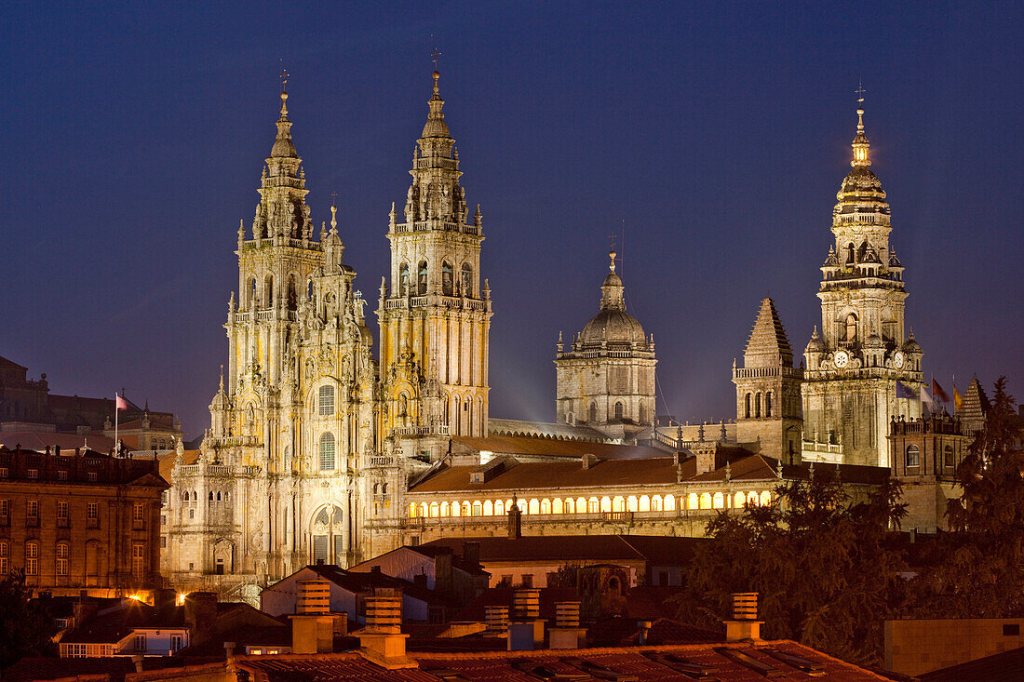
In Spain, dinner is enjoyed later in the evening. Heck, in most of the world the evening meal takes place later than in the United States. But in Santiago de Compostela, the final destination of every Camino route, activity in the old city center can linger late into the evening. It was the day after our arrival in Santiago, the first visit to the city for each of our group. We had already completed all the obligatory customs expected of pilgrims who arrive at the Cathedral in the center of the city. We had obtained our certificates at the pilgrims office, celebrated in the cathedral’s main courtyard with pictures to prove our arrival, and we had attended a pilgrim’s mass, complete with the storied botafumeiro swinging high above our heads.
Dinner had come late, maybe even late for Spaniards. We had spent the day winding our way over mountain passes (this time in a van, rather than by foot) so we could visit the “end of the world” – Fisterra and Muxia – along the Costa da Morte. Fisterra (also called Finisterre) is a dramatic perch above a steep rocky peninsula that juts into the Atlantic. Its Latin roots, Fin, end and Terra, earth, meant that those Romans who gave the area its name believed that they were standing at the end of the earth.
Weary as we were, it would have been easy to call it a night after filling our stomach with local gastronomy. And some in the group did. But I was curious. How often do you get to spend time in a city like Santiago? “Let’s walk around the Cathedral before we head back to the hotel,” I suggested to my daughter. Walking through the narrow city streets toward the cathedral, we passed other shops and restaurants, many still alive with chatter around tables that spilled out onto the pedestrian streets.
The cathedral is a huge baroque-style building that commands multiple city blocks. Walking around it, with its four squares, takes a bit of time and offers not only different perspectives of the building but of the city as well. I wondered; would any pilgrims be found at this late hour? Would the cathedral be ablaze in modern artificial light?
The Praza das Praterias square that earlier in the day had featured brass bands and ques of pilgrims waiting their turn to enter the cathedral was now quiet. So was the Praza da Quintana de Mortos, where earlier we had enjoyed a snack at an open-air bakery. But as we wound our way toward the northern side, we heard a powerful tenor voice performing opera music above the background chatter of many pilgrims who were stopping to listen or passing by. This tenor was taking advantage of the acoustics found in the Arco de Palacio, a pass through under a section of the cathedral that leads to the largest of the cathedral squares – the Obradoiro Sqaure.
Opera isn’t normally going to grab my attention, but there was something about the medieval European city at night that made this genre appealing. He was performing a familiar tune from the Marriage of Figaro and using his performance skills to encourage the crowd that gathered to join him in certain call and response sections of the song. Hearing opera performed masterfully by a street performer in an ancient Spanish city is a memorable experience!
As we entered the large Obradoiro Square, the crowds that had gathered there in celebration of their accomplishment were now dispersed. But we quickly noticed that an equally large gathering of visitors had crammed in under the portico of the Palacio de Rajoy (Royal Palace) where a traditional Spanish folk band was performing energetic numbers to a lively crowd. Galician dancers accompanied the musicians as the crowd gleefully clapped along. Minutes after an upbeat song finished and the cheering from the crowd subsided, the cathedral bell tolled 11:00 pm.

Reese in front of the cathedral, around 11:00 pm. (Yes, its still dusk!)
Each of these happy happenstances were feasts for our eyes and ears. These are the kinds of travel experiences that stick with you for years to come. But happenstance may not be the best way to describe the nightcap to our long day. Better may be the word serendipitous. Serendipity generally means “the development of events by chance in a happy or beneficial way.” But while I didn’t know what I would find by returning to the cathedral at that late hour, I’m not sure that it was completely chance or happenstance, either. Rather, I was drawn by curiosity and open to experiences beyond the expected plans. What my curiosity provided me was a feast of the senses.
Serendipity, I’ve learned, is a word coined by Horace Walpole, fourth Earl of Oxford, in 1754. He first used the word in a letter to Horace Mann to describe a surprising discovery he made. Since the word was new, he takes time in his letter to inform Mann how the word was inspired by fairytales of Persian origin. These fairytales, known in English as the Three Princes of Serendip, were the travel tales of three princes from the Island of Serendip – another name for Sri Lanka. These stories place the young princes in situations in which their observations and discernment allow them to solve riddles that vexed the locals they encountered. Walpole describes the princes this way: “they were always making discoveries, by accident and sagacity, of things they were not in quest of.” In honor of these princes, he refers to his own unexpected discoveries as serendipity. “A very expressive word of accidental sagacity.”
I had to look up the word sagacity. I’ll save you the effort. Sagacity comes from the Latin sagire, which means to perceive keenly. (Its similar to the word sage, but the two words, surprisingly, do not share the same root.) To have sagacity is to possess the ability to wisely discern. And this separates the meaning of happenstance from serendipity. A traveler and more importantly here, a pilgrim, needs to approach pilgrimage with sagacity. Or, to be observant and curious about the path, the people, and places one will encounter. My curiosity and desire to soak in as much of Santiago as I could allowed me a serendipitous experience around the cathedral.
On pilgrimage our senses are heightened. We become are alert to the vibrant colors of flowers we pass, the smells of a roadside market, and the taste of a crisp beer at the end of day’s walk. But at home, what happens to our senses? Do we approach our days with sagacity in order that just maybe something serendipitous will occur? The same spirit of God that shows up in the beauty of flowers or a conversation with a fellow pilgrim is just as available among the events and people we interact with on a daily basis.
One of the lessons I am keeping from my first Camino is that serendipitous moments available on the road are also found at home. I am thankful for the wonders I have encountered in my travels. But my family, friends, and coworkers are gifts, too. There is a beauty in the people and places of central Virginia that matches the majesty I see when I am in a different place. So, my pilgrimage has reminded me of one of T.S. Eliot’s most famous lines from his poem Little Gidding:
“We shall not cease from exploration
And the end of all our exploring
Will be to arrive where we started
And know the place for the first time.”

 liminalpilgrim