Unbridled Spirit

Church in the western world has enjoyed an elevated status for many years.  That status, as we are painfully aware, is no more. And so we mourn the loss of what once was.  But how intently do we look for what will be? Like the exiles in Babylon, do we hang our “harps” on our trees, refusing to sing songs of praise to God (Psalm 137)?  Or, like Jeremiah, do we seek the welfare of the city where we find ourselves planted, no matter the circumstances (Jeremiah 29:7)? Perhaps what’s lost on we who have had the fortune of growing up nurtured by Christian culture is the notion that God’s spirit is not absent, even when we feel it is.  When the Holy Spirit finds welcome and space to work, there is still no holding it back. Which means many churches need to do some soul searching. Because culture has shifted away from the institutional church, will we become paralyzed and thus unreceptive to the Holy Spirit? Or, might this be just the time when God is prepared to do something new among those who are looking for God’s Spirit, loosed among the people?  With this in mind, Acts 8 and its surrounding context is instructive.

Throughout the gospels, we see God at work in a new way through Jesus.  Jesus is not against the purpose of the law, the function of the temple, and the role of those who serve it.  Jesus’ growing concern is that the law and the temple have become a means unto themselves rather than something that points participants to someone far greater.  But the Jewish religion had become an institution that conferred power and prestige back on those who served in its system – giving priests, pharisees, sadducees and the ruling class meaning and clout.  Citizens of Israel identified with the Temple, too. It was the most important monument and the most significant national and religious institution for Jews of the first century. Over time, the function of the temple as a place to worship God had morphed from a dynamic, formative act to an institutional checklist.

Jesus’ challenge to the temple institution, to rediscover and implement true worship, is much of what sends him to the cross.  And the story continues as the gift of the Holy Spirit is given to those who follow the Spirit into places and to people that the temple doesn’t touch or allow.  This movement of the Spirit is acutely evident during pentecost, when the Spirit enters people who are able to see God working in new and even unexpected places. And it doesn’t stop there.  As those among the ranks of Christ followers grow, so does the anxiety of those institutionalized places of power and privilege. In earlier chapters in Acts, we read of the growing power of the apostles who can’t help but continue to proclaim Jesus as Messiah, who call for repentance in order to receive forgiveness, who heal all sorts of sickness and mental illness, and in doing so expose the failings of the current temple culture.  The Sanhedrin’s response to each episode is to react defensively, with fear that this new movement could mean a diminished place of power at best and at worst lead to a change in the people’s traditional view of the temple and God’s unique work in it.

Before completely dismissing the Sanhedrin as selfish men who tried to stand in the way of God’s new Spirit work, can those of us nurtured by the traditions of Christendom try to relate?  In the Temple system, people practiced thousands of years of tradition that, in its best practice, pointed them to the saving work of a God who called them to live committed lives for God’s sake and the sake of the world.  It did have meaning and power. But its meaning and power had shifted over the centuries from an empowering movement to an institutional power that was controlled at all costs. The deliberations of the Sanhedrin in Acts show shrewd planning on how to handle the growing Jesus movement but no active discernment of God.

“What are we going to do with these men?” they asked.  “Everyone living in Jerusalem knows they have performed a notable sign, and we cannot deny it.  But to stop this thing from spreading any further among the people, we must warn them to speak no linger to anyone in this name” (Acts 4:16-17).

However, what marked the Apostles growing movement was prayer and discernment.  What were the apostles response after the threatening words of the Sanhedrin?

“On their release, Peter and John went back to their own people and reported all that the chief priests and elders had said to them.  When they heard this, they raised their voices together in prayer to God… After they prayed, the place where they were meeting was shaken.  And they were all filled with the Holy Spirit and spoke the word of God boldly” (Acts 4:23-31).

So, as we approach our focal scripture in Acts 8, we see tension mounting between the temple tradition and the apostles who demonstrate a new power and authority found outside of the temple.  The apostles continue to gain an audience and larger numbers of followers until things come to a head when Stephen is seized and stoned to death. This, according to Acts 8:1, marks the beginning of a persecution against the Jerusalem church which leads to its scattering throughout Judea and Samaria.  But instead of having a cooling effect on these new believers, it galvanized them more as they continued to preach the word, wherever they went. It is as if the Spirit, not being welcomed in the temple or the holy city, went wherever it was given room and welcome.

This seems to mirror a similar scene in the gospels of Mark 6:8-11, Matthew 10:9-15 and Luke 9:1-6 where Jesus sends his disciples out in pairs with authority to cast out demons and cure diseases and to proclaim the Kingdom of God.  He instructed them to taking nothing with them for the journey but to depend on the hospitality of strangers. Further, he told them if no one is welcoming of them, to shake the dust off their feet as they leave the town. Here, it seems striking that the very city that hosted God’s presence in the temple is the same city that cannot contain the new movements of the Holy Spirit.  And so they scatter to the outcast places, like Samaria, where people receive them and are eager to hear their message.

Enter Philip, one of the deacons chosen in Acts chapter seven.  He makes his way to the place where devout Jews would never want to be found – Samaria.  Yet it is the Samaritans who are enthusiastically responding to the gospel message; who are being healed and cured.  What is most striking is the free way in which the apostles share the Holy Spirit with these new believers. Rightly recognizing that they cannot contain the Holy Spirit, Peter and John pray for the Samaritan believers to receive the Holy Spirit.  The alternative, of course, would be to try to withhold the Spirit from these new converts. What would be the outcome of such a decision other than a repeat of the disaster unfolding in Jerusalem? But the Holy Spirit cannot be bridled. It cannot be controlled.  It moves where God directs it, in unlikely places, among unsuspecting people and in unpredictable ways. Either we get on board with following the Spirit or get out of the way. The apostles chose to follow.

Which makes Philip the perfect candidate to follow the Spirit further, into more unexpected and unchartered waters.  Our focal scripture tells of an angel instructing to Philip to “go south to the road – that goes down from Jerusalem to Gaza.”  This is a unique set of instructions. So much so, many Bibles footnote it. Check it out. The Greek word is used as both a location (south) and a reference of time (noon).  In this case, the wilderness road between Jerusalem and Gaza is a southward direction. But the timing may also be important. After all, who sets out by foot down a barren road at the noon hour?  Traveling habits of the day incorporated morning and evening travel. In other words, no one travels when the sun is at its highest and hottest. And who else would be out on such a road? Yet, Philip obeys and who does he find but an Ethiopian eunuch on his way back to his home country from Jerusalem.

This Ethiopian traveled in style, shaded by the heat and sun by a chariot and all that came with such travel.  I take that to mean he had at least a driver. Maybe an attendant, too (8:38). He had to have someone else driving the chariot; after all, he was reading from the Isaiah scroll.  This Ethiopian is a fascinating character study. He was wealthy and in charge of an even larger wealth as the queen’s treasurer. He was a foreigner, and is described as an Ethiopian.  If he had dark skin, he was not looked down upon because of his color. Rather, Ethiopians were idealized in ancient classical writings as people of great piety and beauty. Herodotus extolled the ‘burnt-skinned’ Ethiopians as the tallest and most handsome of all humankind; and Diodorus of Sicily commented that ‘it is generally held that the sacrifices practiced among the Ethiopians are those which are most pleasing to heaven.’” Further, the Jewish scriptures speak highly of Ethiopians for their upper-class status as powerful people economically and militarily.

The Ethiopians high standing, however, does not get in the way of his humbly seeking and accepting the instruction of divinely-directed wisdom from the prophet Isaiah and the interpretation of a fellow traveler on this wilderness road at such a strange hour.  In fact, it is humility that has intrigued the Ethiopian as he reads the scripture of the suffering servant found in Isaiah 53. Perhaps it was not just humility in the positive sense of the word that attracted him to this scripture. Of course, I haven’t mentioned his other descriptive quality that was certainly humiliating; his identity as a eunuch.  It is likely that his role as treasurer to the queen, which brought wealth and prestige, also brought with it the necessity to be castrated in order to serve in her court. For the Jews, whom he had been worshiping among in Jerusalem, his state as a castrated male would have placed him in a position of dishonor and impurity. Deuteronomy 23:1 states that no male in his situation should be admitted into the assembly of the Lord.  Josephus, a first century Jewish historian, regarded eunuchs as unnatural monstrosities who must be shunned on account of their gross effeminacy and impotence. Philo considered eunuchs as ‘worthless persons.’ Whatever economic and political worth he possessed in some circles and whatever value he attached to the Jewish faith, the Ethiopian eunuch was regarded as socially and religiously worthless among leading segments of Israelite society.

Yet, the Jewish prophetic scriptures also offers more hopeful prospects for eunuchs.  Isaiah foresees a day when pious eunuchs and foreigners, which this man was both, would be welcome into the temple and given a permanent place in the household of God (Isaiah 56:1-8).  In fact, one cannot escape the imagery here: eunuchs will be given a monument and name better than sons and daughters (which they cannot have) and a name that cannot be cut off (well, you know how that works for eunuchs).

So the eunuch is certainly intrigued by this suffering servant Isaiah describes.  But there has been no one to help him understand who Isaiah is speaking about. “How can I (understand what I am reading) unless someone guides me?” he asks.  And how could he know? While he was in Jerusalem to worship, his status prevented his acceptance in the temple courts. As he was heading back to his home, there must have been a mix of confusion and frustration as he continued to wrestle with the scripture in front of him.  He identified with the situation of the man described in the scroll. But what became of him? What did it mean? And Philip was there, as directed by the Holy Spirit, to help him understand the scripture in light of Jesus.

The scene ends with the eunuch’s simple question:  “what is to keep me from baptized?” The answer seems so clear to us: nothing!  There is water, there is his confession that Jesus is Lord. But for the Ethiopian eunuch, the question also points to more than function and pragmatism.  What lingers in his question quite possibly is the rejection he has felt among the temple in Jerusalem. There, as the law made clear, he was not allowed such privileges.  Would the Jesus way be any different?  Philip’s response gave a clear indication. And since Philip was directed to this desolate desert road by the Holy Spirit, his purpose was to continue the kingdom building Christ had started in Jerusalem by replying to the eunuch’s question in the affirmative.  Nothing is to keep you from being baptized! Nothing is to keep you from being given a name that cannot be cut off.
The work of Jesus has opened up to the outcast, foreigners and the unclean what once appeared to be off limits.  The early Christians sensitivity to the stirrings of the Holy Spirit provided them the joy of participating in God’s growing mission in the world.  For Christ followers today, What traditions in the current church may keep us from sensing the movement of the Holy Spirit?  What practices can we foster so that we can recognize and be responsive to God’s mission and movement in our culture?

The Model Shepherd

John 10:11-18; Ezekiel 34; Psalm 23

Barbara Brown Taylor tells a story which we all can relate.  Her husband and a friend went duck hunting on the Flint River.  After a full day on the river, the time came to return to shore and load up for the trip home.  After beaching their boat on the shore, the two men began loading their decoys and guns in a car parked near the shore.  When they returned for the boat, it was no longer there but was floating back in the river some ten feet from the bank. As they waded in after it, the motion their bodies made in the water only pushed the boat farther from them toward the main current of the river.  It soon became apparent that one of them would have to jump into the water and swim to the boat. Taylor’s husband told her he knew it wouldn’t be him. “After all, it wasn’t my boat.”

Jesus is making the same point when he identifies himself as the good or model shepherd. And this metaphor works for his purposes because the vocation of shepherding was both a major economic activity in Palestine in Jesus’ day and was emblematic for the relationship between  God and God’s people in the Hebrew Bible. Here is what we know about shepherding during the time of the gospels, from Jesus and His World, An Archaeological and Cultural Dictionary:

Shepherds led their flocks by walking ahead of them, in contrast with butchers who drove them to slaughter.  Shepherds had individual vocal signals to call their own sheep, and it was effective even if the animals were mixed with other flocks.  The sheep recognized and obeyed the voice of their own shepherds.

Shepherds were expected to see that sheep had food and water; they had to account for the animals in their charge.  When a sheep stumbled into a ditch or crevice, the shepherd pulled it out with a crook or curved staff. If the sheep was injured the shepherd carried it to a safe place across his shoulders and attended to its wounds.  In order to protect the flock against thieves and many predators, including wolves, hyenas, jackals, bears and leopards, shepherds were often armed with a slingshot, a rod, a club and a knife.

In the winter, flocks stayed within a few miles of the villages and at night were brought back to the enclosures of individual farms or put together in a communal fold kept by a guard or doorkeeper.  In the spring and summer, the flocks were driven to higher pastures, in the mountains of Upper Galilee, Samaria and Judea. There, shepherds found large caves or built sheepfolds of dry stones to keep out the wild animals.  In that case, they slept at the door which was the only opening in the wall without a gate.

Shearing occurred twice a year, at the end of the winter and summer grazing; as in the case of the harvest, it was a festive occasion.  Despite the idyllic image of the relationship between shepherd and sheep in popular tradition, the reality is that the animals were raised to be sold, offered as sacrifice, sheared, and eaten.

Shepherding was so much a part of the life of Israel that the word sheep and its cognates, lamb, ewe and ram, appear more than five hundred times in the Bible.  In biblical imagery, God, the king, the leaders, and in the New Testament, Jesus, were allegorized or symbolized as shepherds. The leaders in the biblical story were not always the good “shepherds” they should have been, and many prophets are critical of the corrupt leaders.  (See Ezekiel 34, for a strong example.) The same imagery is found in John 10.

So what does this mean for our lives?  Sheep need a leader. Once they learn the voice of the shepherd, they trust this voice to guide them to green pastures and still waters and deliver them from enemies.  Really, sheep do not know right from wrong without the steady hand of the shepherd. Is Jesus calling us to become “dumb” like the sheep and uncritically trust his voice?  He seems to say a similar thing when he admonished his disciples, saying: “Let the little children come to me, and do not stop them; for it is to such as these that the kingdom of heaven belongs” (Matthew 19:14).  and “Truly I tell you, unless you change and become like children, you will never enter the kingdom of heaven” (Matthew 18:3).

I think it is clear that Jesus valued children and didn’t see them as dumb.  Rather, Jesus is pointing out that children and sheep do tend to depend upon and trust adults who have their best interests in mind.  And when both children and sheep recognize a good shepherd, they put their faith in their leadership completely. In other words, they no longer need or want to be the shepherd.  They are willing to be led. What does Jesus’ words about sheep and children say about our need to be in control? How easy is it to relinquish control to someone else? In varying degrees, this is one of the western world’s largest challenges and our biggest sins.  We think we know best and are completely capable of steering our own ships.

So how do we do it?  We learn the voice of the shepherd.  And this is the daily task of learning his voice.  This voice is found in scripture, for sure. It is found also in prayer that begins with placing God as the focal point of our life (Our father, who is in heaven, how holy is your name!).  And prayer that invites God’s values to become our values. (Thy Kingdom come, thy will be done on earth as it is in heaven.) When the practice of prayer, Bible study and worship become routine in our life, the voice of the good shepherd comes to us more clearly over the cacophony of daily life that wants the individual to be in control and thus to be threatened by others outside of our control.

In contrast, the voice of the good shepherd tells us that he is in control of all the situations around us.  That he would even sacrifice his own life in order to save ours. So there is no need to worry about safety or what’s around the bend.  And there is no need to be threatened by the other sheep who are in other pens. If the shepherd knows them and they know his voice, then they too are ultimately a part of one flock.  In the shepherd’s flock (God’s Kingdom), all are welcome.

The challenge Jesus left his disciples as he ascended to heaven was that the shepherding will still go on.  But, in the short time between his death and resurrection, something happened to his first followers. Their identity as sheep had been transformed to shepherds.  Once their ears were attuned to the sound of Jesus’ voice and hearts equipped with the guidance of the Spirit, their vocation became like that of their master. They were sent out to find flocks of their own and to “do for them as I did for you.”

  • How does our desire for control keep us from trusting the good shepherd?
  • Why does fear keep us from trusting others and from embracing the diversity of God’s Kingdom?

Excerpts taken from:

Taylor, Barbara Brown, Bread of Angels, p. 80.Crowley: Boston, 1997.

Arav, Rami and John J. Rousseau, Jesus and His World, An Archaeological and Cultural Dictionary, p.251-253. Fortress: Minneapolis, MN, 1995.

A Living Picture of God’s Kingdom

Jesus does a lot of amazing things in Luke 36-49.  He “appears” out of seemingly nowhere; but he’s not a ghost.  He’s got the skin, the bones, and the scars to prove it. And he eats with them; ghosts don’t get hungry.  And, as if he hasn’t done this over and over again before his crucifixion, he explains why, despite his indiscriminate love, he suffered and died and rose again.  And finally, the light begins to turn on for the disciples!

But maybe the most amazing thing that Jesus does in this scene is something overlooked by we contemporary readers.  Jesus calls them witnesses of these things (Luke 24:48) Jesus doesn’t give them a choice. Not, would you like to be my witnesses?  Can you be my witnesses? No, he states a truth. Because you are here, because you followed me and because I’ve explained to God’s plan as I stand before you in a resurrected body, you are a witnesses.  No avoiding it. No going back.

This may make sense for those disciples who were present in the room where it happened; who saw the risen Lord and experienced his teaching first hand.  But what about us, with 2,000 years of separation between those first eye witnesses? How are we witnesses to this good news we read about in the gospels?

Truth is, Jesus’s empty tomb work is showing up everyday, all around us, if we have the eyes to see it.  For the longest time, I thought I had to be the one to create these situations, as if it was up to me to do the resurrecting!  No wonder witnessing carries a negative connotation for most of us, though many of us wouldn’t want to admit it. But that’s a burden too large and heavy for us.  Besides, God’s already accomplished the work. We just have to point it out when we see it!

Too often, I think I have to be a witness to Biblical theory or doctrine instead of being a witness to the simple story of God’s work.  When I do that, however, I’m making the good news all about me. Its bound to go wrong with that approach. Rather, instead of being in control of God’s witness, I’m learning that God is at work all around me.  Oftentimes, it’s in the hard places in life. All I need in order to be a witness to God’s salvific activity is be present to God’s spirit moving around me. If we believe what Jesus said, that we are witnesses to God’s good news, then we have the eyes and the ears and the heart to be aware of this.

Jesus promised God would aid us in this work with the gifting of the holy spirit (Luke 24:49 and Acts 1:8), so we shouldn’t be under the impression that this witnessing work is on our shoulders.  If we believe God still works through the Holy Spirit, all we have to do is daily ask that we be aware of God’s Spirit at work and then look for it expectantly. God will use our story and the resurrection story to point out in our work, in our families and in our neighborhoods that resurrection still happens; that there is another story at work rather than power and dominance. The alternative or real story is the Kingdom of God and that everyone is invited to experience.

David Fitch, Professor of Theology at Northern Seminary address this posture of witnessing in his short volume entitled Seven Practices for the Church On Mission:

Every day in our neighborhoods, amid strife, broken relationships, and tragedy, whether we are Christians or not, we need the gospel.  Christians must play host to spaces where the gospel can be proclaimed. As we gather around tables and the various meeting places of our lives, if we will be patient and tend to Christ’s presence among us, the moments will present themselves for the gospel to be proclaimed contextually and humbly out of our own testimony.  And in these moments, Christ will be present, transformation will come, and onlookers will catch a glimpse of the kingdom. This is faithful presence.

The Psalm for this week reminds us that people long for stories about resurrection – that life can be good.

“There are many who say, ‘oh that we might see some good!

Let the light of your face shine on us, Oh Lord!’

You have put gladness in my heart

More than when grain and wine abound.

I will both lie down and sleep in peace;

For you alone, Oh Lord, make me lie down in safety.”

Psalm 4:6-8

We are witnesses to Christ’s resurrection story and the Spirit’s ongoing resurrection work today.  People are longing to lie down and sleep in peace, which is to say, they long to be whole. It’s not up to us to make this happen.  Rather, we just need to be available to point to where these deep needs in everyone can be found. And do it with gladness in our heart.

  • What does Jesus mean when he calls his disciples witnesses?
  • What are examples of being a witness in society?  (Witness a car crash, a winning shot, a wedding, etc…)
  • Does a witness do the acting or simply the reporting?
  • What emotions come with being a witness for Christ?
  • What stands in our way of being a witness?
  • What help do we have in being a witness?
  • Do Christians sometimes make witnessing harder than it has to be?

Hope Restored

What happens when hopes aren’t realized?  When the things you have believed in or worked hard for fail?  Is it better to have no hope than to have hopes that are dashed?  These must have been the complex emotions of those people who left their nets, their families and their homes behind and hung all their hope on the itinerant rabbi from Nazareth.  As they followed, they witnessed time and time again Jesus teaching with authority, the healing in his touch, the grace in his voice and the blessing in his eyes. This was no ordinary rabbi.  And he spent his time with such ordinary people, which gave them hope. A hope that something special, even revolutionary was brewing. He spoke in riddles and parables but it all seemed to point to a claim he continued to make.  He was special. He was the son of God. He was Israel’s long-awaited Messiah.

But he hung out with the ordinary, even marginalized folk; not people of power, like the priests and lawyers.  He spoke about forgiveness and turning the other cheek, not a violent over-throwing of the Roman occupation. Jesus was different.  His kingdom was about giving up power and trusting the words of God fully. God was in control. God would prevail. God’s people must love God and love neighbor as oneself.  Even their enemies deserved their love. It sure was different than anything they had heard of before but they went along, often stumbling and doubting. Jesus was quick to correct but patient to the end.  Jesus made them believers in the Way. A new Kingdom was on the horizon. It would come about by God’s doing, not human action.

Yet, in the end, were they foolish to believe the world would ever operate differently?  Instead of love triumphing, it was the powerful, the wealthy, the possessors of violence and fear that dashed their hopes.  One of their own sold Jesus out for just thirty pieces of silver. That’s all it took. It’s hard to resist power and money.  Once Jesus was under the authority of the ruling class – the Romans – and their uncomfortable bedfellows, the priests and Sadducees, it all moved quickly.  The revolution was squashed with the violent death of a man who only loved everyone he met. His one crime? Exposing the excesses of the religious elite and their propensity to love themselves rather than embracing the privilege to serve God and others.

In the aftermath of such devastation. Mary Magdalene, Mary the mother of James, and Salome were walking to Jesus’ tomb in the early morning light.  What must they have been thinking and feeling? The man who had so inspired them and gave them a hope they never knew possible was suddenly no more.  The authorities once again had proved who was really in charge. As Cameron Murchison mentions in Feasting on the Word, “The women on their way to anoint Jesus’ body (may have been) making peace not only with the death of Jesus but with the death of Jesus’ claim to embody the reign of God for the well-being of the world.”   What sadness, fear, and even depression must they have been feeling on that early morning walk? Have you ever walked in their shoes?

The utter despair of the time between Good Friday and Easter Sunday is all but lost on most of us who follow in the Way.  We leave the Good Friday service touched by the sacrifice of Christ but with chores to do, soccer games to attend on Saturday, and the Easter ham to prepare.  Life goes on. We know how the story ends.

But for these women, who thought the story had ended in death, and for the disciples, who fled in fear for their own lives, the darkness and despair were real.  So imagine, if you can, the disorientation, the confusion, the utter change in perspective the empty tomb and the angel provides these ladies. Utterly stunned? I imagine it would have taken time for me to work all this out.  To hash my experience out with other followers. Then, to begin to comprehend that, in fact, this new Way is possible. It is real. What’s more, the powers of violence and self-preservation had taken their best swing at God’s son and had fallen short.  The cracks of man’s kingdom were showing and God’s Kingdom was possible, after all.

It’s a great story – and a true one, too! So now we must ask: what does this reality, Jesus raised from the dead, mean for me?

  • How do I live in the reality of the resurrection when it seems like the powers of deception, confusion, domination, violence and self-aggrandizing are in firm control all around me?
  • What does resurrection say to me when my life seems out of control and hope is lost?
  • In whom do I trust?  The creator of all things and the one who raises the dead or what I see and touch and hear?
  • How does the power of God and the power of man present differently in our world?  Which is easier to follow?

The angel’s instructions to the women were to go and tell.

  • For the women, who expected to find Jesus’ dead body, would this have been a hard task?
  • When we experience amazing, transformative experiences, how do we respond?  Are we compelled to talk about the news? Is it fun or hard to share our experiences?
  • What happens when the new of resurrection is not shared?

May the sudden, good news of Easter transform our lives and make us eager to go and tell!

The Road Leading to Jerusalem

The beginning of Holy Week, the scene in which Jesus makes a “triumphant entry” into Jerusalem, is a scene that is ultimately political.  Jesus demands his followers make a choice between two kings and kingdoms. Since chapter eight, when Peter and the disciples recognize that Jesus is the Messiah – the King of the Jews – everything that Jesus has done and each step they have taken have led them to this point.  Jesus has continually set before them illustrations of what God’s Kingdom looks like against the reality in which they live. Parables and healings have been interspersed with predictions that such a movement will lead Jesus to the cross. Jesus makes it clear that we cannot have it both ways – loyalty to the status quo makes one an enemy of God’s Kingdom.  Likewise, loyalty to God’s Kingdom and King Jesus makes one an enemy to those that wield power through any means other than servanthood.

The stakes are high.  Jesus knows the costs and continues to explain them to his disciples.  Challenging the powers will get you killed. But the price of living fully the life God designed far outweighs the false choice of living life in competition with one another, looking out for oneself at the expense of others.  Servanthood is the calling God places on each of us – carrying one another’s burdens as equals, rather than rivals.

Jesus’ remarks, in Mark 10: 32-45, sum this up.  Jesus is on the road to Jerusalem with his disciples.  He knows this road will end in Jerusalem with suffering and humiliation.  The disciples still think it will end triumphantly. Which makes Jesus’ triumphant entry all the more jarring for we who know how the story goes.  Along the road, Jesus pointedly tells the disciples that he would be handed over to the authorities, not as a hero but as a traitor. Immediately, after what should be frightening news, James and John ask Jesus to “grant us whatever we ask.”  Those demanding words end up being a request for special status when God’s kingdom comes.

Ever been talking to your kids and as soon as you finish explaining some serious life lesson, they abruptly change the topic around something they want?  These two disciples seem to have had the same problem. Have the been listening? Do they not understand? Patiently, Jesus once again explains the difference between ‘pagan’ rules and God’s Kingdom.

You know how it is with pagan nations, he said. Think how their so-called rulers act.  They lord it over their subjects. The high and mighty ones boss the rest around. But that’s not how it’s going to be with you. Anyone who wants to be great among you must become your servant.  Anyone who wants to be first must be everyone’s slave. Don’t you see? The son of man didn’t come to be waited on. He came to be the servant, to give his life “as a ransom for many.”

It’s with this understanding that Jesus makes his entry into Jerusalem.  It’s God’s holy city but it’s a city far from God, filled with people more concerned with getting ahead, no matter who may get stepped on in the process.  It’s a city Jesus can’t rule over. It’s a city with an agenda moving in the opposite direction of his calling; living opposed to his rules. While the common among them may have greeted Jesus as a king, the powerful wouldn’t let Jesus get any further than this simple ride on the back of a donkey.

Such background work has been helpful to me as I approach Palm Sunday.  To see Jesus’ entry through the lens of his journey to Jerusalem, against the cultural norms in which he lived, and through the not-quite perceiving eyes of his disciples paints a picture of two competing ethics:  An ethic of self-promotion that isolates and an ethic of servanthood that welcomes community. For Mark, it’s the ethic of servanthood and community that motivates Jesus’ actions and stories during the week leading up to Good Friday.  This holy week, may the simple ethic of servanthood overcome the loud and prevalent ethic of self-promotion. May we make enough room in our busy days for the presence of Christ to slow us down and correct our inclinations for self and open us up to the blessing of serving others.

  • What keeps us from accepting the posture of servanthood?
  • How are we like James and John?
  • Is it easy to recognize the difference between self -promotion and servanthood?  Are the differences more subtle than we like to think?
  • What habits must we change in order to be a servant?
  • What positions or things are we holding on to that prevents us from embracing servanthood?
  • What does a community that submits to each other look and feel like?
  • How is that different than our present communities?
  • To whom is such a community the most attractive?

Read Mark 8:1 – 10:52 prior to class this week.  Challenge your class to do the same. Will Jesus’ triumphant Entry look different after a close reading of these stories?

Challenge your class to continue its reading during holy week, following Jesus’ passion: Mark 11:1- Mark 15:39.  Does the servant ethic continue?

Transforming Grace

The old Peanuts cartoon has Snoopy on top of his doghouse, anxiously waxing philosophical, asking:

“Where am I going?  What am I doing? What is the meaning of life?”

snoopy

Deep questions, certainly.  Trouble is, do we find ourselves asking that question enough?  What is the point of our life – of any life? What am I doing about it?  Does the direction I go make a difference?

For Paul, these were the big questions.  They were the questions he gave the rest of his life to understand and to give an answer for on behalf of everyone he encountered.  His own life was his biggest and best answer. He had been living the life of the upward and respected. He knew “what was what” and he worked hard to maintain his place in Jewish and Roman life.  But, one day, on the road to put those pesky Christians in their place, he met Jesus. And life as he knew it changed. What was up became down. And he understood love, mercy and grace for the first time.  For the first time, Paul didn’t and couldn’t earn his way. It was freely given. Which made him want to do a whole lot.  Not for himself but for everyone else. Because he now possessed a grateful heart.  Everything now was gift and the gift needed to be shared, not hoarded.

This is what led Paul to write all those letters, as difficult as they are to understand, sometimes.  Like Christ was transformed on the other side of the resurrection, so too was Paul on the other side of Damascus and so too are each of us every time the Spirit shows us just how out of control we really are, left on our own, yet how very blessed we have become to be called children of God.

So transformation is the heart of the matter of the lesson for this Sunday as it is also at the heart of the letter to the Ephesians.  God’s grace has transformed us to understand our whole existence, our direction, our whole purpose in a different light. We are fundamentally different creatures with a different purpose after our baptism.  The tension that remains is we live in a hostile world that either is looking in the dark while asking the same questions as snoopy or has completely ordered their lives around a purpose that amounts to little more than “me.”

For those of us who are new creations in Christ, Paul wants us to remember where, like himself, we have all come from.  And for those who haven’t yet discovered their potential newness, the household of God is to be a clear signpost for the hope they can have in a new life and purpose in Christ, and a firm direction for getting there.

The best I can do to help you guide your class in encountering Paul’s message is offer my own visual summation of Paul’s message in Ephesians 2 and to offer two perspectives from theologians much better versed in communicating just what transformation is.

First, I offer you Eugene Peterson’s overview of Ephesians.  To understand Paul’s overarching goals in his letter is to better understand his reasoning in chapter two.

What we know about God and what we do for God have a way of getting broken apart in our lives.  The moment the organic unity of belief and behavior is damaged in any way, we are incapable of living out the full humanity for which we were created.

Paul’s letter to the Ephesians joins together what has been torn apart in our sin-wrecked world.  He begins with an exuberant exploration of what Christians believe about God, and then, like a surgeon skillfully setting a compound fracture, “sets” this belief in God into our behavior before God so that the bones – belief and behavior – knit together and heal.

Once our attention is called to it, we notice these fractures all over the place.  There is hardly a bone in our bodies that has escaped injury, hardly a relationship in city or job, school or church, family or country, that isn’t out of joint or limping in pain.  There is much work to be done.

And so Paul goes to work.  He ranges widely, from heaven to earth and back again, showing how Jesus, the Messiah, is eternally and tirelessly bringing everything and everyone together.  He also shows us that in addition to having this work done in and for us, we are participants in this most urgent work. Now that we know what is going on, that the energy of reconciliation is the dynamo at the heart of the universe, it is imperative that we join in vigorously and perserveringly, convinced that every detail in our lives contributes (or not) to what Paul describes as God’s plan worked out by Christ, “a long-range plan in which everything would be brought together and summed up in him, everything in deepest heaven, everything on planet earth.  -Eugene Peterson’s introduction to Ephesians, The Message.

Our goal as teachers is much the same as Paul’s. To help Christ-followers understand that to celebrate the gift of God’s grace without any sign of real transformation is to miss the point entirely.  To be a new creation in Christ is just that – we are changed people; transformed, with a new way of seeing, understanding and relating to the world around us.  We have the answers Snoopy is looking for. Yet transformation most of the time isn’t the flash of blinding light Paul experienced. Rather, it is a gradual change that requires the prayers and the practice of a people, together.  It takes work. The church encourages this change in one another, but not for the sake of the church or ourselves. Instead, this transformation, though meaningful and deep, is for the sake of the world.

To better compare and contrast what Paul is describing in Ephesians 2, I’ve drawn a little diagram: image002

Lastly, one of the most creative storytellers and theologians in our recent history is Frederick Buechner.  Follow this link to read a moving description of Paul’s transformation and the different and purposeful work that came out of Paul’s conversion.  It is worth the read and paints a beautiful picture of the transformation found in embracing God’s grace. Good work doesn’t earn us a place in God’s good grace but God’s good grace motivates us to work to reflect a good and loving God.

Questions:

  • How do you know when someone has changed (transformed)?
  • Is all change good?
  • What makes for good change?
  • Is change easy?
  • In a system that elevates the individual above a community, what will be the sacred cows that stand in the way of transformation to Christ-likeness?

Encountering the Ten Commandments for the First Time, Again.

This Sunday’s lectionary text is a very familiar one – even for marginal church attenders and those have no desire for church.   It is the first account of the giving of the Ten Commandments (Exodus 20:1-17).  We hear a lot about the Ten Commandments these days.  Especially where they should be or shouldn’t be displayed.  Everyone has an opinion.  Everyone is looking to control them.  But what does God have to say about the commandments that God gave?   These, after all, are created and given by God to humankind for our good.  In assuming this is an old and familiar story, are we missing how the commandments are life-giving?  In the fight for where they fit into our cultural life, are we missing the commandments purpose?

In my study this week, I’ve been challenged to see the commandments anew – as a life-giving gift that helps us lead a life that reflects the character and image of God.  If God is trustworthy, faithful, peaceful and desiring of relationship with creation, then we must live our lives in ways that resemble this.  Often, we read these commandments as negatives.  And they are written as such … “thou shall not…”  But the commands are parameters that are given for our benefit.  What if the class was challenged to write the commandments in the affirmative:  “Thou shall…”  or “You get to…”  or “Blessed are those who…”

In lieu of my own exegesis this week, (theological talk for critical explanation or interpretation of a text) I offer you all the following resources that shaped my study this week.  They are worth your consideration.  Two commentaries found online:

http://cep.calvinseminary.edu/sermon-starters/lent-3b-2/?type=the_lectionary_gospel  Be sure to scroll down to the Exodus commentary found after the commentary on the gospel lesson.

http://www.workingpreacher.org/preaching.aspx?commentary_id=2368  This commentary is more dense but worth wading into.  Among other things, it address our proclivity to control God rather than to allow God to guide us.

Finally, a reflection from Barbara Brown Taylor, found in the Feasting on the Word preaching commentary:

“Since the giving of the Torah on Sinai is celebrated during the Jewish festival of Shavuot, a wealth of story and tradition surrounds the first hearing of the commandments.  One midrash says that the people had little choice but to accept Torah from God, since God plucked up Sinai and held it over their heads, threatening to drop the mountain on them if they did not received the commandments.  In happy counterpoint to this legend, more and more religious Jews observe the first night of Shavuot by staying up all night to study Torah, Talmud and other sacred writings together.  They offer this annual all-night gathering, known as tikkun, for the mending of the world.”

If nothing else, stories and traditions like these remind Christian interpreters of the Ten Teachings that these teachings have been around a long time.  They are never our possession, any more than the God who uttered them is.  Instead, we stand among a people counted as God’s peculiar possession, set apart by holy speech and practice for the mending of God’s holy world.”  -Barbara Brown Taylor

How can the world be mended by our living in response to the Ten Commandments?

Taking Up Our Cross

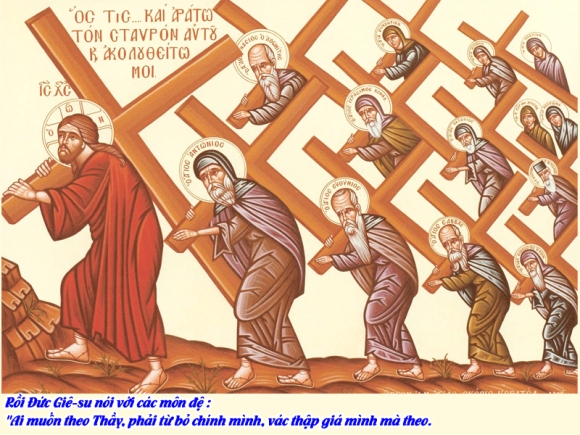
The challenge to those we teach today is to understand the cross and apply it to our circumstances.

What is a cross?  Its symbolism and meaning are ubiquitous today.  It’s certainly more than an intersection of two lines.  It’s a fashion accessory for many.  We see it in appear in all types of art.  For sure, its a symbol of our faith.  We see placed prominently in Christian churches of all stripes.  We see it used as a memorial and in cemeteries.  Its presence can bring peace and assurance to our life and faith.  But unfortunately, it has also been misused over time as a symbol of intolerance, threat and fear.  Certain “Christian” bodies have used it to signify that their perspective is right and all others best move out of the way. While this is as far from the message of Christ as one can get, it actually is in keeping with the original Roman intent for the cross.

A Roman cross wasn’t a thing of beauty.  It was something to be feared.  It was an instrument the Roman authorities used to establish their rule far beyond Rome as they subdued people and civilizations that stretched as far north as modern day England, as far south as Morocco, and as far east as Iraq.  In doing so, they achieved a span of about 200 years, between 27 BC and 180 AD, which is known as “Pax Romana,” or Roman Peace.  During this time, their empire thrived, intricate roads were built connecting this vast empire and aqueducts carried fresh water into cities and dirty water away.  But the cross may have been one of its most useful instruments.

The cross was a popular method of dispatching threats to the empire. “Romans practiced both random and intentional violence against populations they had conquered, killing tens of thousands by crucifixion,” says New Testament scholar Hal Taussig, who is with the Union Theological Seminary in New York.

Crosses were then used as a way to repress any possible insurrection.  They were usually set up in public places, like at a crossroad, and became a signpost to all who traveled that Caesar and Rome was a power to take seriously.  This cross did not offer people traveling directions but rather, with a corpse left hanging on it offered directions of another kind:  Know your place in this Roman order and everything will remain peaceful for you.  Make even the slightest waves in opposition and you can expect to join this man on your own cross.  These “signposts” were found all over the Roman world.

This is what the disciples had in their minds when Jesus, after being identified as the Messiah, announced “If any want to become my followers, let them deny themselves and take up their cross and follow me.”  Can you imagine both the horror and confusion that must have surrounded them?  This gifted rabbi that people had been flocking to hear speak and be healed by is telling us that he is the long awaited savior of our people.  He’s the Messiah!  But instead of saving us from the oppressive Romans, he is asking us to embrace their form of submission!

No wonder Peter, who first identifies Jesus as the Messiah, reacts so forcefully at Jesus’ teaching of his rejection.  Peter, like many of us, wants to take control of the situation and preserve his leader and movement.  Given the context of the Roman world, perhaps Jesus is simply stating a fact.  If I am what you say I am, the local authorities and ultimately Rome’s response will be to kill me.  But Peter’s desire to fight fire with fire was not the agenda God had planned for his son.  And, after forty days of training in the wilderness to resist satan’s temptations, Jesus’ work pays off as he resists any plan of self-preservation, even when it comes from his star pupil.

Would-be messiahs were nothing new in first century Palestine.  More than a few had risen to prominence, with their own band of disciples and the cause of God and nationalism as their banner.  Violence and death were always their end as they resisted the empire’s strength.  After each demise, there was nothing left to show for their efforts.  Jesus’ call was to embrace, on behalf of his followers, the path of savior through martyrdom.  Looking back at the witness of Christ in the gospels, it appears that part of God’s beautiful plan was that only through the embrace of self-sacrifice can the movement of God’s reign ever come in any significance.

What does this scripture have to say to followers of Christ today?  What kind of self denial and cross is Jesus asking us to carry?   And how abrupt and difficult is such a message to our ears?  To answer, we must first start with the question, “who do we say Jesus is?”

Who do we say Jesus is?  This question makes all the difference.  If we are going to take up our cross, we first have to believe the cause is worthy of suffering.

This is the question that gets this whole scene started.  Jesus and his disciples have been traveling from town to town preaching God’s kingdom, casting out demons and healing the sick.  He’s developed quite a fan club.  And Jesus wants to gauge his disciples by asking them about the folks they are encountering.  What are they saying about me?  Do they recognize me?  But ultimately, he wants to know if they, who have been with him the most, recognize him for who he really is.

When Peter makes his confession, the wheels start to turn. A messiah by any other name than Caesar is someone with a mark squarely on his shoulders.  The disciples have given up everything to follow him.  With this news, they may have to give up their life.  Peter and the others were probably ready to die for Jesus’ cause, to go down swinging in a fight against the evils of the empire.  What Peter did not like, what he didn’t fully understand, was Jesus’ acceptance of what seemed like defeat.  His teaching that he would die seemed like a certainty, not a possibility.  How could the Messiah be victorious when he was ready to accept death at the hands of the enemy?

Yet, as the story plays out, Jesus’ death is not the end but rather the beginning.  Jesus’ death changes everything.  Jesus’ willingness to trust fully in God’s authority over everything rather than the Ceasar’s violent version of reality, put Jesus on a cross but brought those who follow him life.  Today the Pax Romana is but an ancient history lesson.  But the gospel of Christ is embodied in every person who believes and follows.  Jesus’ death and resurrection was the ultimate signal that humans, no matter how powerful or threatening they appear, can’t really have any lasting power over God’s creation.

So, how we understand who Jesus is will make a difference in how we understand the cross that Jesus asks us to carry, and our willingness to pick it up and follow him.  What is our cross today?  Is it worth our sacrifice in order to bear it?

The challenge to those we teach today is to understand the cross and apply it to our circumstances.  The cross may not mean a literal death or martyrdom.  Rather, it may mean that we have to daily say no to things that stand in the way of our ability to fully trust in God alone.  What systems and technologies do we trust more than God?  Are we able to fully claim the way of Jesus above the way of capitalism, a particular political point of view, the threat of violence, a work ethic that drives us to continuous work or lifestyles that compromise our ability to see God at work and join God there?

These lifestyles, as an example, are not necessarily scandalous.  But, it very well may be in our comfort, in our overwhelming options of how to use our time and wealth, that we choose being served rather than serving. What does this look like?  If it is a continual guilt trip, then we don’t want it.  But, I think the Jesus way is a simple truth that our life is more than the conveniences we have become enslaved to.  As we follow Christ, we start to recognize this but too often we give into our own Peter rebuking us, trying to keep us safe, in a predictable place we can control.

Following Jesus is a greatest adventure.  Walking in his footsteps brings us purpose beyond anything else society can offer.  The tension is that society doesn’t want this adventure and doesn’t trust it or celebrate it.  Society wants to stay in a system that is predictable and controllable.  The adventure of faithfully following Jesus will either go under the radar of popular culture or it will be rejected.  This is just one of the crosses we as Christians are called to bear.  Being unpopular, crazy or both.

So, what does it mean to bear our cross?  We have collective crosses we must bear faithfully for God such as coming to terms with gun violence in America.  And we all have our own crosses that require sacrifice and faith to bear.  What will it look like for a community of Christ followers to bear our burdens (our crosses) together?  Is it possible?  I pray and hope that it is.

For a radical example of taking up the cross, Greg and Helms Jerrell have followed Jesus’ call to minister among a marginalized neighborhood in Charlotte, NC (http://qcfamilytree.org/).  Instead of pastoring in a church setting, which would have perhaps brought them more comforts and middle class lifestyle, they were called to Enderly Park.  Their choice has made them who they are and they wouldn’t change a thing!  A mission team will go to serve with them and learn with them June 27-30.  Sign up at http://www.hrbcrichmond.org/my-hrbc

Our Limiting God

“This is the sign of the covenant I am making between me and you and everything living around you and everyone living after you. I’m putting my rainbow in the clouds, a sign of the covenant between me and the Earth. From now on, when I form a cloud over the Earth and the rainbow appears in the cloud, I’ll remember my covenant between me and you and everything living, that never again will floodwaters destroy all life. When the rainbow appears in the cloud, I’ll see it and remember the eternal covenant between God and everything living, every last living creature on Earth.” – Genesis 9:12-16, The Message

We study a familiar story this week, but we skip the two-by-two part along with the rains come tumbling down section and head straight to what God promises creation after the floodwaters subside.  In Genesis 9, we find the first mention of a covenant in the Bible.

In the ancient near east, a covenant was an agreement between two groups.  Most always, this agreement was a promise made by a conquering kingdom to not destroy the conquered kingdom and even protect this people in exchange for access to the conquered’s resources and land.  The agreement is reciprocal but not equal:  We the conquering will not destroy you but will protect you as long as we have access to the resources that will make us greater.  There is clearly a have and a have-not.

What we see in the covenant promise that God makes to Noah’s family on behalf of all creation is different.  Clearly God is the powerful player in this scene.  God has just all but wiped out his creation, save for Noah’s family and the two-by-twos.  But as one scholar puts it, God appears to be just a little shocked at the display of his strength toward creation. Therefore, God makes a unique covenant, a one-sided covenant, with the people and animals that God delivered.  In doing so, he sets his bow down in the clouds, as a warrior would do when he has come home from battle.

This rainbow becomes a sign for God and a reminder that he will never destroy creation again.  The rainbow acts as a reminder to God.  I admit I’ve never given much thought to the rainbow being a reminder for God.  I’ve always seen it as a reassuring sign for creation.  Why does God need reminding?

Perhaps it is because when God promises to not destroy, God is limiting his ability to bring to an end to his creation.  And from time to time, humanity’s propensity to selfishness might just frustrate God enough to consider it again.  And why would God want to do this?  If we look back to Genesis 6:5, we read that God saw the wickedness that had overtaken all of creation  – that every inclination of the thoughts of their hearts was only to evil continually.  And God is sorry about his creation – enough to blot them out; except there is Noah. So God saves the only family that found favor in his sight.  And God destroyed the rest!

We don’t spend much time on this part of the flood story, do we?  We love the faithfulness of Noah and the way God saves his family and all the animals.  Its safe.  We make it a children’s story and decorate nurseries with these images.  But the times leading up to the flood and the catastrophic flood are far from G-rated!  There are very adult themes here.  God was fed up with the evil in his creation’s heart.  Seems like the world was like Las Vegas, times ten!  Even God’s angels got into the mess, falling in love with women and impregnating them with giants!  Really?  Read Genesis 6:1-4.

To harken back to Adam and Eve’s original sin, it appears that the people of Noah’s day had no regard for God or his commands, which were created for the purpose of humanity’s flourishing.  People had their mind set on evil, day and night (6:5).  I take this to mean people did whatever made them feel good, putting their desire ahead of the good of the whole and the order that God had created.  Such disregard for God, the divine parent who cared so much for creation, was enough for any mortal to give up.  And for a moment, so the scripture says, so did God.

But there was Noah. God provided the necessary instructions for Noah’s family to survive.  They boarded a ship and the floods came.  But what about all those bent on evil?  What happened to them?  They got what they deserved, right?  Can you picture the hopeless struggle as the waters rush and rise?  Its not a pretty sight.  And now that Noah, his family and the animals had survived, God, fresh from his victory in battle, is ready to lay his weapon down for good.

What must it be like to be angry at creation?  Many of us have been angry at our children, sure.  But angry enough to kill?  Is this really the kind of God we read about in the rest of our Bible and worship?  Its hard to imagine.  But his wrath is right there in scripture. Is there more to this?

Since the beginning, civilizations have had their flood narratives.  What does one do when everything they know is wiped out by rushing water?  When lightening strikes from the sky?  Thunder rolls overhead?  We know a lot about the weather today (although not enough to control it or even predict it well).  But in ancient times, this was all mysterious and assigned to the anger of God.  Certainly, we know that sin is pervasive and at times almost irresistible to humanity.  Its can be enough for anyone (even a deity) to want to give up.

Recalling that much of the Torah was written down during the Babylonian exile, what might the homeless Israelites have thought of this story?  They believed their continual sin had carried them away into exile.  Might flood stories also be explained as righteous anger?

The beauty of God’s covenant is that, no matter the cause of the flood, we see God taking initiative to promise that no matter what evil may come in the future, God will not destroy, even though it may be tempting as evil can be so frustrating and hurtful.  But God is willing to be limited so that even when humanity turns to evil all the time (and I think we can admit it still happens) God will refuse to destroy.

With this in mind, I think the story can be more about who the LORD God is in contrast to those other near eastern gods.  Whatever resemblance God and the flood may have had in other flood stories, the covenanting God who limits his power out of love and compassion for creation is a far more compelling and, in the end, powerful.  It is also a foreshadowing of God’s final redemptive work through Jesus, as he limits himself all the more, taking the form of a human and denying any divine privilege. (Philippians 2)

What I take from this story is God does hate the state that sin leaves us in but loves us so much that he finds another way around the sin problem.  It wasn’t through destroying his wayward creation but being vulnerable enough to conquer the sin that would put Christ to death.

One last feature I noticed, with the help of others: God’s bow – the rainbow – is taut, as if strung and ready for action.  A bow that is strung will look more like the bending arch in the sky than one that is not loaded.  This could reflect that God is patient with his creation even though his patience is tense, full of pent up energy.  He’s laid his bow down but it doesn’t mean God is OK with the evil that remains in creation.  And because God was willing to suffer at the hands of evil, God knows all the better the terror that it inflicts on us.  Just look at the evil that leads one teenager to kill so many other innocents this week.  And even how we are becoming so used to it.  So, no.  God isn’t OK with the evil that woos us.  So, just as the rainbow is a reminder to God that he will never destroy his creation for even this, the strung, tense bow should also be a reminder that God doesn’t take our sin lightly.  In righteous love, God has defeated evil through his incarnational sacrifice.  But in God’s righteous anger, God is still burdened by the sin that keeps us from fully knowing and seeing his love, this side of the kingdom.

Therefore, I believe that anyone who suffers for righteousness sake, who stands up for God’s creation in the face of evil can expect to suffer but also expect to be blessed.  (Beatitudes, Matthew 5)

  • How does our lesson speak to God’s radical love in the face of even the heartbreaking events of this week?
  • While God will not destroy us because of our sin, what might the taut roundness of the rainbow reveal about God’s attitude toward sin?
  • Following God’s example, should our attitude toward sin be different than our attitude to those who sin?  How does our attitude toward sin and sinners reflect that God’s Kingdom is available to all?


Brilliant Dust

On Wednesday, we observed Ash Wednesday, the beginning of the season of Lent.  In comparison to other Christian observances, this one may strike us as the strangest. On our way to resurrection and God’s plan of making all things new, what do we need to know about frailty, dust, death and repentance?  Lent, oddly, reminds us of our place in God’s larger story.  Still not a fan?  Hear me out.

The common refrain we hear during the imposition of ashes are the words: “Remember, you are dust and to dust you shall return.”  Pleasant, I know, but this is on purpose.  In Genesis 2:7, we read of how God formed man from the dust of the ground.  We are created from dust.  And if we pay attention to the places we live and work, we notice we are good at creating dust.  Our bodies are constantly shedding and creating new skin. We are literally dust.

But the story doesn’t end with dust.  Genesis 2:7 continues to say “the Lord God breathed into the nostrils of this man and he became a living being.”  We are who we are because we carry God’s breath.  The word for human or man in these verses is adam, which means dirt in Hebrew and adamah means ground or land.  So God formed us from the dirt of God’s creation and gave us our uniqueness among all creation when God breathed divine breath into us.

Equipped with God’s life-giving breath, God empowers humans to have dominion over the dirt of the world.  With our God-given breath, we are able to cultivate life from the dirt which sustains us and all other living creatures.  But if we are honest, we are also capable these days of much more than sustaining lives.  We are also capable of destroying life, too.

As we quickly see in the next two chapters of Genesis, these special creatures called humans are also capable of turning their backs on their creator and capable of destroying God’s very good creation.  So, from Genesis 4 through today,  we continue to deal with this tension of creativity and destruction.  We see such beauty in our world.  People are capable of such kindness and self-sacrifice, one to another.  But people are also capable of destruction, cruelty and selfishness, too.

And before we, who were given the responsibility of divine creativity, alters God’s good work to an unrecognizable wasteland of greed and hubris that leads to destruction, we need a reminder of who we are and our place in God’s world (not our world).  The jarring words “remember – you are dust” are there to save us.  God created you with divine breath.  You bear the resemblance of God.  But you must also remember that none of us are God.

Acknowledging that we are not God is getting harder these days.  No one really goes around calling themselves god.  But check our behavior.  How often do we as individuals or as a society consult with our creator before moving ahead with our latest project that may impact the earth, the oceans or fellow human beings?  Our behavior reflects our unwillingness to accept that we are dust, that our bodies wear out and that our planet is also finite.  What it does show that we are deeply interested in ourselves.  We would make poor gods, at least when compared to the true God in whose likeness we are created.

And since we are created in God’s image and with God’s breath, the good news in all of these ashes is that there is deep meaning and purpose in our lives.  When we acknowledge that God created us with the responsibility to take this very good creation and do something beautiful with it, well, that should both scare us and excite us!

To quote one theologian’s musings on our spectacular dustiness:

“To regard ourselves responsible for our future, responsible for the very human race itself and the very planet itself, is not arrogance but recognition of the truth.  But all such human responsibility depends on one immense condition, that we never forget that we too are creatures, children of the same Majesty who formed the planet and the suns and galaxies which surround us.  In that sense, created and formed, given the gift of life, we are dust.  Brilliant dust? Yes.  Creative, thinking dust?  Yes, but still dust.  For all the brilliance and creativity and thought and imagination within that dust are the shimmering traces of that divine breath within us.”  -Herbert O’Driscoll, A Year of the Lord

Put a different way, we’ve been given this one brilliant and beautiful gift of a life from our creator.  How will we use it?  Will it reflect the intention and desires of our Lord?  Will it lift up and and bless both the creator and creation as worthy investments of our time, our creativity and praise?  Or will our abilities be forgotten and lost in self-adulation and even destruction?

Such questions remind me of a Switchfoot song, Live it Well, which asks the same kind of questions.